Don't Trust the Facade: An Optical Walking Tour of London
London is a city of extremely confident frontages. Which is odd, because a decent chunk of them are fibbing. Not maliciously — more in the way that a Georgian developer with a budget, a railway engineer with a cutting to hide, and a chancellor with a fixation on windows all left their fingerprints on the same few streets. Once you know what to look for, you can't stop seeing it. Terraces that aren't quite as deep as they look. Windows that were never windows. A house that is, on closer inspection, a wall.
The good news is that this is a walking city, and the lies are close together. Below is a loose route — three stops in the centre, two outriders a Tube ride away — plus a short section on how to spot the tricks yourself, because the pleasure here isn't ticking off curiosities. It's catching them in the act.
Stop one: Seven Dials, where the streets do the lying
Start at the pillar. Seven streets converge here, and the whole point of the layout was to make a scruffy bit of Covent Garden feel like a legible little village with a monument at its centre. It works, briefly. Walk up Monmouth Street and the pub ahead of you sits dead centre, squarely framed, as though the road runs straight at it and stops. Twenty paces later the picture falls apart and the street has slid off to the left.
That's the trick: the geometry is only coherent from one or two vantage points, and the rest of the time it's a delightful mess. There's a small joke built in, too — the pillar carries six sundials for seven streets, a discrepancy nobody has ever satisfactorily explained. Stand at the junction of Neal Street and Short's Gardens and watch the pillar vanish and reappear behind the rooflines as you move. Cheap thrill, excellent use of five minutes.
Stop two: the house built out of sightlines
Walk south to Lincoln's Inn Fields and the Sir John Soane's Museum, which is free, and which is essentially a magician's prop cupboard dressed as a house. Soane was obsessed with how a room feels rather than how big it is, so he used mirrors, false perspectives and shallow domes to inflate small spaces into something cathedral-like. The breakfast room appears to continue past its own wall. Walls unfold. Corridors are shorter than your eye insists they are.
It's the best possible primer for the rest of the walk, because it teaches you the central rule: an illusion only works if you're standing in the one spot the designer had in mind. Step sideways and the whole thing collapses. Free entry, closed Sundays and Mondays — book a timed slot even though it costs nothing.
Stop three: Bloomsbury's bricked-up eyes
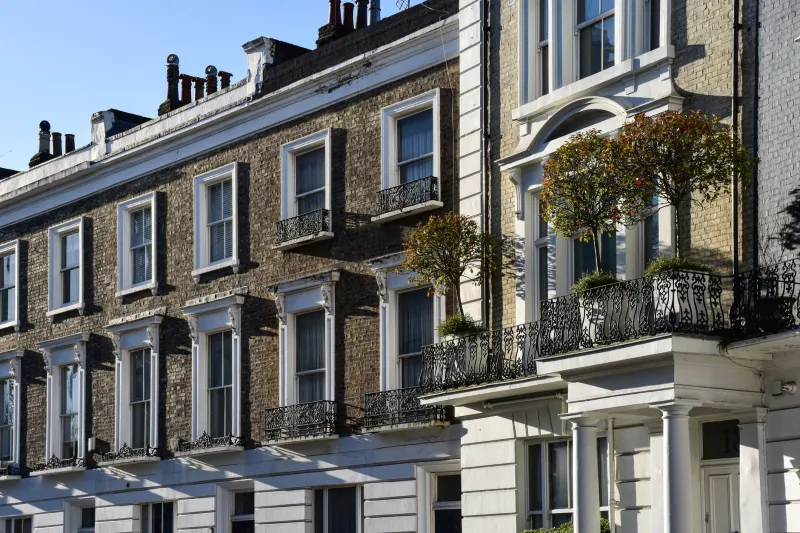
Ten minutes north and you're in Bedford Square and the streets around it, where half the terraces are wearing windows that aren't there. The reason is the window tax, introduced in 1696 and fiddled with upwards for the next century and a half until it was finally repealed in 1851. Householders were charged by the number of openings, so people bricked them up — and developers, keen to keep a facade symmetrical without paying for glazing and glass duty, simply built blind windows from the start.
Here's what separates the two. A real window is set back into a reveal, has a sill and a shadow line under the lintel. A bricked-up or blind one is flush, often in slightly different brick, with no depth at all when the sun rakes across it. Look for the ghosts on upper floors — ground floors were usually spared because shopfronts and trade needed light. Gower Street and the terraces off Russell Square are thick with them. Once you've clocked three, you'll spot thirty.
Outrider one: the sliver opposite South Kensington
Take the Piccadilly line to South Kensington and walk to the top of Thurloe Place, where a building appears to be about eighteen inches deep. It isn't — it's a wedge, and the point of the wedge is aimed straight at you as you come up from the station. Forced perspective does the rest. Move fifty metres in either direction and the building fattens up apologetically, like a cat caught mid-scheme. Best seen on a bright, low-lit afternoon when the two visible faces of the triangle fall into different tones and the edge reads as a hard line.
Outrider two: the houses that aren't houses
Finish at Leinster Gardens in Bayswater, and bring a bit of patience, because the whole thing hinges on a detail. Numbers 23 and 24 are handsome white stucco townhouses in a long terrace, with columns, cornices and a proper portico. They are also solid wall. There's no building behind the facade, just the open cutting of the District and Circle line, which was driven through the terrace in the 1860s. Rather than leave a gaping hole in the streetscape, the railway kept the front of two houses standing so the neighbours could keep pretending the terrace was intact.
The tell is the windows: dark, curtainless, no reflection, no letterbox, no door furniture, and a 'front garden' that is a slab of paving. It's much more convincing than it has any right to be, which is why people walk past it daily without noticing. The nicest pay-off is that you can ride straight through the gap behind it — the train between Paddington and Bayswater passes inches from the back of the lie.
How to catch a lie, generally
Four things give almost every one of these away. Shadow: real depth casts it, paint doesn't. Look at the underside of sills and the sides of reveals. The ground line: fake buildings tend to meet the pavement too neatly, with no wear, no step, no grubby transition. Colour drift: stucco painted to imitate stone, or a rebuilt bay in newer brick, almost always reads a shade off in flat winter light. And the camera test: photograph it, then look at the picture. Illusions built for the human eye often die instantly on a screen, which is exactly how you confirm you've found one.
Also: look up. Almost all the good stuff sits above shop level, at the height nobody's eyes rest on. And take the top deck of a bus now and then — the elevated angle flattens facades in a way that makes their fibs obvious.
Practicalities
The central leg — Seven Dials to Lincoln's Inn Fields to Bedford Square — is about forty minutes of walking, or a comfortable half-day if you go into the Soane. The two outriders need a Tube hop each: Piccadilly line to South Kensington, then the Circle line round to Paddington or Bayswater. November and December are honestly the best months for this: a low, raking sun between about eleven and two is the city's most honest lighting, because it throws long shadows down every pilaster and exposes anything that's only pretending to have depth.
Go with someone who'll tolerate you stopping every ninety seconds. Or go alone, which is better, because you'll want to stand still and squint, and nobody needs an audience for that.