Before the Downbeat: The Free Warm-Ups Worth Loitering For in London
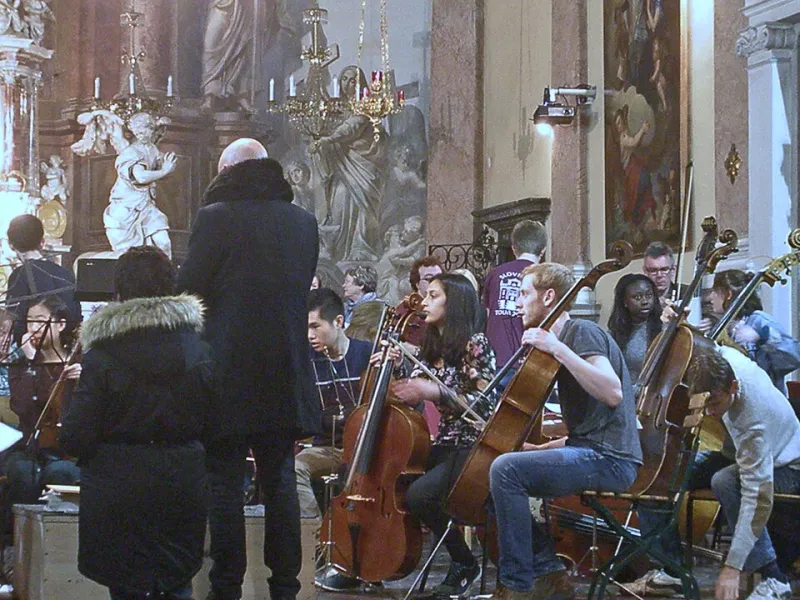
Photo: Amanda Slater from Coventry, West Midlands, UK, CC BY-SA 2.0, via Wikimedia Commons
The best music in London usually happens before anyone is allowed in. Half an hour before the doors open at a concert hall, an orchestra is working through the tricky bit for the fourth time. On a Wednesday lunchtime, a choir is finding its tuning in a City church with the lights half on. In a conservatoire corridor at 11am, a violinist is playing the same eight bars until they behave.
None of it is advertised. All of it is free, if you know where to stand and how to behave.
The half-hour before the show
A rehearsal isn't a cut-price concert; it's a different thing altogether. You hear the working-out — the stopping, the conductor's low voice, the moment a passage finally locks. It's the sound of music being made rather than delivered, and it's far more intimate than anything you'd pay for.
Where to listen in
City churches, weekday lunchtimes
St Bride's on Fleet Street, St Giles-in-the-Fields off Shaftesbury Avenue, St Magnus the Martyr by the Monument — all of them have choirs and organs and rehearsals that spill out into the pews. St Bride's, with its wedding-cake spire, often has music going on in the middle of the day. Sit at the back, don't clap unless invited, and leave quietly if the door closes behind you.
Concert hall foyers
The Royal Festival Hall foyer is one of the great free music spaces in Europe. The Clore Ballroom hosts free gigs and workshops most weeks, and on concert evenings the whole place fills with players warming up before they head backstage. The Barbican's Level G does something similar, with free sets from jazz and contemporary artists early in the evening. Wigmore Hall's foyer is small enough that a string quartet tuning up counts as a performance. Cadogan Hall on a concert night is worth a detour for the queue alone.
Conservatoire corridors
Royal College of Music in South Kensington, the Royal Academy of Music on Marylebone Road, the Guildhall School by the Barbican, Trinity Laban in Greenwich: all four run free recitals and open rehearsals during term time. This is the best value in London music and the least well known — the listings are buried on their websites, but they exist, they're usually unticketed, and the audience knows exactly what it's listening to.
Unlikely rooms
The Wellcome Collection, the Royal Institution, hospital chapels, the crypt at St Martin-in-the-Fields, St Bartholomew the Great in Smithfield — all of them host rehearsals or free lunchtime music that nobody thinks to list as something to do.
The times that work
Weekday late mornings, roughly 10.30am to noon, are peak rehearsal hours. Wednesday lunchtimes are the traditional slot in the City. Concert evenings, 6pm to 7.15pm, are when foyers fill with players and the odd stray note escapes. Conservatoire recitals run on term time only — avoid August entirely.
The etiquette, briefly
Sit at the back and slightly to one side. Don't clap between movements, and honestly don't clap at all unless everyone else does. No filming — most musicians are mid-rehearsal and not in performance mode. Don't walk across the conductor's sightline. Don't ask a steward what time it starts; it isn't that kind of event. If a door is shut and there's a notice on it, take the hint.
A Saturday route worth trying
Start at the Royal College of Music in South Kensington for whatever free recital is running, walk down to Cadogan Hall to catch the pre-concert bustle, then head across town to the Barbican for the early evening foyer set. Three lots of music, one travelcard, nothing spent.
Why it beats a ticket
A concert gives you the finished article, which is fine and often wonderful. A rehearsal gives you the thing itself — the counting, the frustration, the half-second where a hundred people get it right together. You'll leave humming something you didn't know you knew, and you won't have spent a penny.