Faded Letters, Living Streets: A Field Guide to London's Painted Shopfronts
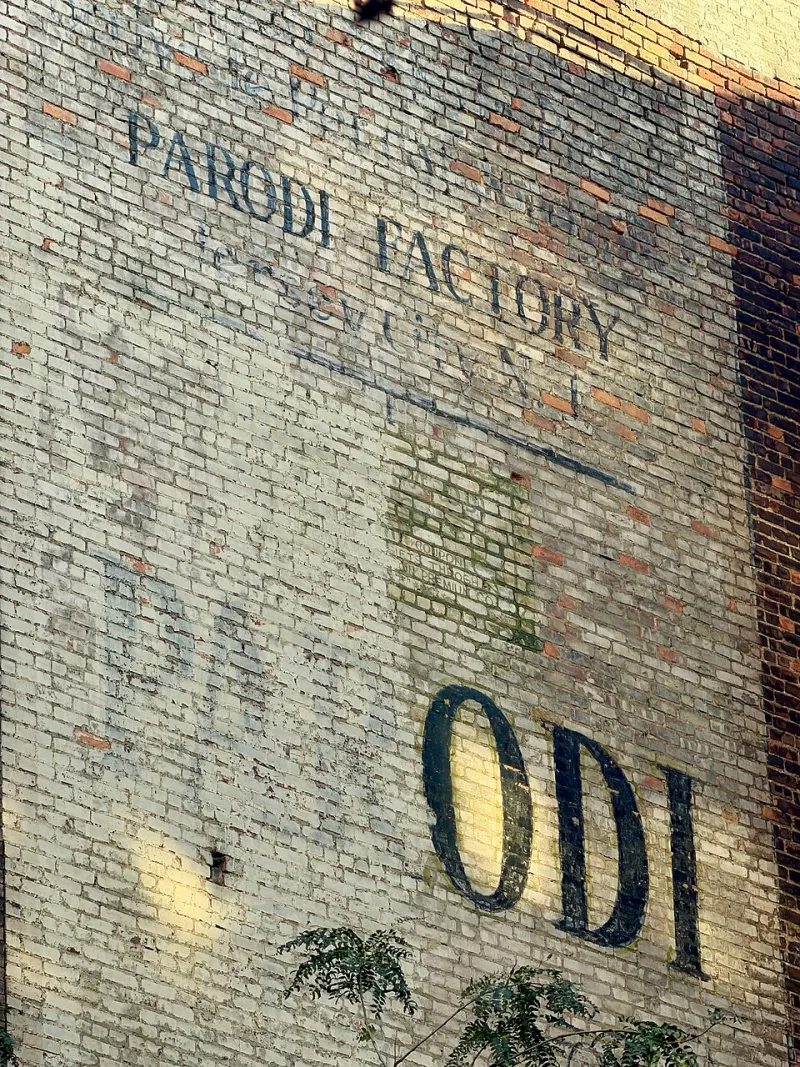
Photo: Oleg Yunakov, CC BY-SA 4.0, via Wikimedia Commons
There's a wall off Clerkenwell Road where three eras of business are stacked on top of each other like sediment. At the top, the ghost of a Victorian clockmaker's name in white capitals, the paint now the texture of a scab. Underneath it, a 1950s repaint in a colour nobody would pick today. Underneath that, a roller shutter, a vape shop, and a Deliveroo sticker. Nobody intended to leave a record. That's precisely why it's worth reading.
London is unusually thick with this stuff — hand-lettered wall adverts, tiled shopfronts, brewery plaques, brass plates by doorbells, and pub façades that stopped serving years ago and now sell small-batch gin. They survive because nobody could be arsed to remove them, and they vanish because a developer can always be arsed to remove them. Which is why this is best done now, on a Saturday, when the light is flat and grey and nobody is in a hurry.
First, learn what you're actually looking at
Roughly four species turn up again and again.
- Painted wall adverts. Big, hand-lettered, usually for products rather than shops — bread, tobacco, tea, boot polish. Often on the gable end of a terrace where a taller building once stood.
- Tiled and hand-painted fascias. Shopfront lettering in enamel or gold leaf, often with the trade in the corner: 'Est. 1889', 'Family Butcher', 'Watch & Clock Manufacturer'.
- Brewery and trade plaques. Cast iron or stone, marking a pub's owning brewery or a warehouse's trade. These are the most durable and the most overlooked.
- The repurposed front. A pub or shop that has changed trade but kept its architecture — the curved corner, the etched glass, the black-and-gold fascia now advertising natural wine.
The tell is usually the brickwork. Bricked-up windows, patched render, a lintel with nothing under it — all signs that a façade has been edited rather than replaced.
Clerkenwell and Holborn: the workshops
Start where London made things. Clerkenwell was the clock and watch trade for the better part of two centuries, and if you walk the lanes between Clerkenwell Road and Bowling Green Lane with your chin up, you'll keep finding it: lettering above doorways advertising clock manufacturers and jewellers who packed up before the war. Much of it is fragmentary — a surname, a trade, a number — and all the better for it.
Head south into Holborn and the signage changes register. This was grocery and provisions territory, and the surviving lettering tends to be larger and more boastful, painted high on side walls above what are now coffee shops and serviced offices. Stand at the right angle and you can still make out the old letter-spacing, which is more generous than anything a sign-maker would do now.
Bermondsey: leather, hide and the smell of money
The Leathermarket on Weston Street is the obvious starting point — a Victorian market building for the leather trade, with the kind of confident stone lettering that assumed the industry would last forever. It didn't, but the lettering did. From there, work the streets towards Tanner Street and Long Lane, where warehouse frontages still carry trade names in faded paint above loading bays now occupied by design studios and arch cafés.
This is the best area in London for what you might call accidental archaeology: signage that has been painted over, then flaked back into view, so that two companies from different decades share the same wall in a way neither would have agreed to.
Peckham and Brixton: retail before the chain
Rye Lane is a masterclass in layering. Look above the shopfronts on the western side and you'll find traces of the old department stores and drapers that made Peckham a serious shopping destination before the 1960s. Some of the lettering is barely decipherable now — a ghost of a ghost — but the scale of it tells you what the street once was.
Brixton rewards the same technique. The tiled fascias around the market and along Atlantic Road are unusually intact, partly because tile is hard-wearing and partly because nobody has yet worked out how to remove it without taking the wall with it.
Whitechapel, Bethnal Green, Hackney: the layer cake
On Whitechapel Road there's a survivor worth the trip on its own: a restaurant sign that predates most of the buildings around it, still legible, still attached to a business that has been through several lives. It's the kind of thing you'd walk past a hundred times and never notice until someone points.
Further east, Hackney and Bethnal Green specialise in the dead pub. The corner boozer with the curved front and the etched windows is now a bakery, a gallery, or a shop selling candles that smell of woodsmoke. Some have kept the brewery lettering. Some have kept only the shape. Both are worth a stop — the shape is often the more eloquent document.
How to look without looking lost
A few practical notes.
- Walk on the same side of the street in both directions. Ghost signs face one way; you'll miss half of them otherwise.
- Midday and midwinter are your friends. Low winter sun rakes across faded paint and makes it legible in a way summer light never does.
- Look at first-floor level and above. Almost everything worth seeing is between the first and third storeys.
- Check alley mouths and car park walls. Adverts were painted where they'd be seen by people waiting, not by people browsing.
The camera, and the courtesy
Photograph from the pavement, not the road. No flash — it flattens the flaking and makes the lettering unreadable. If a sign sits above a working shop, ask before you start shooting; most people say yes, and the ones who say no usually have a reason. Don't climb walls, don't move bins, don't prop a ladder against someone's window for the sake of an angle.
And if you post it, say where it is. Half the pleasure of these things is that they're shared, not gatekept.
Buy something while you're there
The independents now occupying these buildings are the reason the façades still exist. A coffee, a loaf, a pint, a paperback — it's a cheap way to say that a street with a bit of history on it is worth keeping. Stand outside long enough and you'll notice something else: the businesses that move into old shopfronts tend to leave the lettering alone. It's good for trade, and it's good for the rest of us. Go and look before someone sands it off.