The Hiss Before the Halo: An Evening Walk Through Gas-Lit Westminster
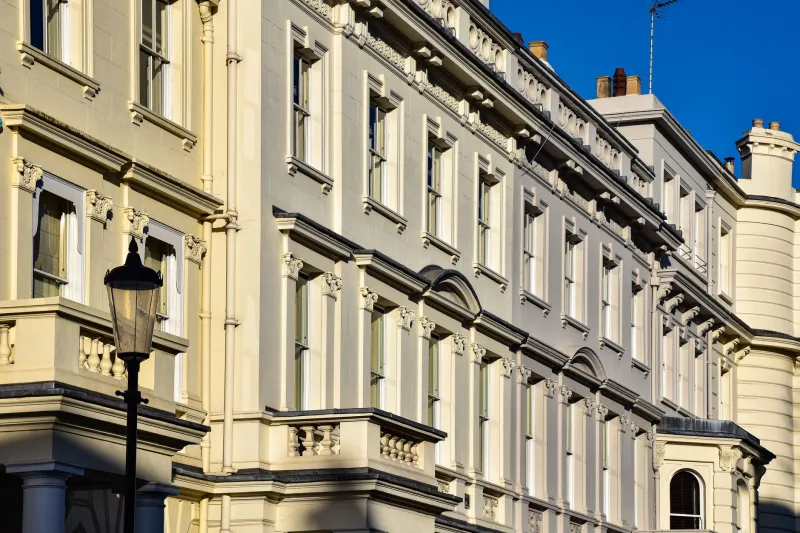
At twenty past four on a Tuesday in November, Queen Anne's Gate does something the rest of London has largely forgotten how to do. A small clockwork mechanism inside a cast-iron post clicks, a mantle glows green, then white, and a pool of warm light appears on the pavement. No flicker of an LED, no harsh blue-white. Just a hiss, like a gas ring, and the smell of hot metal.
This is lighting-up time — not a metaphor, but an actual event that happens across roughly a thousand streets in Westminster every evening between October and March. London still has working gas lamps. Not museum pieces, not the odd preserved specimen behind a rope: working, maintained, lit. You just have to know where to walk.
The first lamp on Pall Mall
The story starts in 1807, when Frederick Albert Winsor lit a stretch of Pall Mall with gas — the first street in the world to be lit this way, or near enough. It was a stunt as much as an infrastructure project; crowds came to gawp. Five years later the Westminster Gas Light and Coke Company was incorporated, and by 1813 Westminster Bridge was gas-lit. Within a few decades the city had tens of thousands of lamps and a small army of lamplighters, each with a pole and a round.
Electric arc lights arrived on Holborn Viaduct in 1878, and the gas lamp's fate was sealed — or so everyone assumed. Yet here we are in 2026, and the lamps are still going. Westminster City Council looks after around a thousand of them, many of them listed, and a very small team keeps them alive. The Royal Parks have their own stock, and the Inns of Court — particularly the Temple — are thick with them. If you have ever walked through Middle Temple at dusk and felt the centuries shift under your feet, that was gas.
The route: St James's Park to the Temple
This is a two-and-a-half-mile walk, best started about half an hour before sunset. In November, that means setting off around 15:45. Bring a torch (phone is fine) for the darker stretches, and wear shoes you would trust on wet leaves.
Start at St James's Park station and go into the park. The lamps along the lake path come on early, and the combination of gaslight, water and the silhouettes of pelicans is one of the underrated sights of central London. Walk the north bank towards Buckingham Palace, then leave the park at the Wellington Barracks end and turn up Buckingham Gate.
Queen Anne's Gate is your first proper street. It is a broad, quiet Georgian terrace with some of the best-preserved gas lamps in the city, and at dusk the effect is uncanny — the light is soft enough that the buildings look older than they do by day. Turn left onto Barton Street, then right onto Cowley Street; both are short, dark and lit almost entirely by gas. Smith Square, with St John's looming at one corner, is a natural pause. From there, Tufton Street leads down to Dean's Yard, where Westminster Abbey's choir school plays football under lamps that have been burning since before anyone thought to photograph them.
Cut through to Parliament Square, cross Whitehall at the lights, and follow the Strand east until you can turn down Middle Temple Lane. The Temple is a warren of gas-lit courtyards and alleys; if you only do one bit of this walk, do this. Finish at The Harp on Chandos Place, or The Coal Hole on the Strand, both of which feel like the right sort of place to thaw out.
Who keeps them burning?
The maintenance team is small — small enough that Westminster's gas lamps are effectively a craft survival project. Each lamp has a clockwork timer that needs winding, a mantle that needs replacing, and glass that needs cleaning. Some still have to be lit by hand. The team's rounds are not the stuff of municipal legend for nothing: they are among the last people in Britain doing a job that was once as common as bin collection.
Why bother? The lamps are listed, for one thing, and ripping out a listed lamp is not straightforward. But the real reason is affection. Every few years a council somewhere announces it will convert gas lamps to LED to save carbon and money, and every few years there is a small, furious campaign to stop it. People love these lamps in a way they do not love a traffic bollard. They are the last bit of the old city that still behaves like the old city: timed, tended, slightly unreliable, warm.
There is an environmental argument, and it is not trivial — gas lamps do burn fossil fuel. But Westminster has so far kept them, and in 2026 the lamps remain part of the borough's identity in a way that a thousand LED retrofits could never be.
Practical notes
- Timing: lighting-up is roughly 16:00–16:30 in November, moving earlier as December approaches. The lamps are on timers, so they do not all go at once — that is half the pleasure.
- The Temple: some gates close in the evening; check before you commit to the Middle Temple stretch, or approach from the Strand side.
- Warm-up stops: The Buckingham Arms on Petty France (tiny, reliable), The Two Chairmen on Dartmouth Street, The Antelope on Eaton Terrace (a slight detour, worth it), The Harp on Chandos Place, The Coal Hole on the Strand. The Grenadier in Old Barrack Yard is the classic Belgravia option if you start further west.
- Etiquette: do not touch. They are hot, and the mantles are fragile.
A last hiss
Stand on Queen Anne's Gate at about half four, and you can watch the street light itself. No switch, no app, no announcement. A click, a hiss, a small green flare, and then a hundred and something years of habit doing its work. London is not short of spectacle. But there is something about a gas lamp coming on in November that makes the city feel briefly, genuinely old — and all the better for it.