Water Works: A Thirsty Walk Through London’s Original Refill Stations
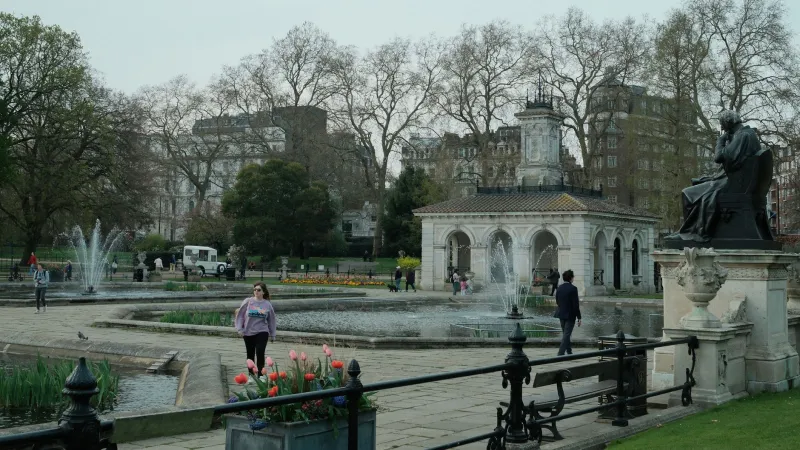
London is full of things that look like furniture until you know what they are. A granite block by a park gate. A shallow stone basin at ankle height. A cast-iron spout that hasn’t produced a jet since the last century. These are the leftovers of a Victorian public-health experiment that once put free drinking water within reach of anyone who needed it — and in 2026, they make a surprisingly good walk.
On a grey November morning, with a bottle in your bag and no particular hurry, head east. The point isn’t to complete a checklist. It’s to learn the grammar of these objects: the tall plinth with the high basin, the low trough for animals, the inscription that names a donor, the modern stainless-steel refill point that quietly does the same job a century and a half later.
Start with the showpiece
Begin at the Baroness Burdett-Coutts Memorial Drinking Fountain in Victoria Park. It is the grand version of a very practical idea: a Gothic canopy in granite, erected in 1862 and paid for by Angela Burdett-Coutts, the Victorian philanthropist whose name turns up all over London’s public goods. It looks like a monument because it is one — but it is also a tap with a roof.
The fountain is not always running, and that is part of the lesson. Victorian drinking fountains were built to last; they were not built to be maintained forever. Some have been restored, some have been capped, some have been repurposed as planters. Treat the Burdett-Coutts fountain as your orientation point, not your guaranteed water supply. The park’s cafés and modern refill points are where you actually fill up.
The association behind the stone
Most of the public fountains and cattle troughs you’ll spot around London came from the Metropolitan Drinking Fountain and Cattle Trough Association, founded in 1859 by Samuel Gurney and Edward Thomas Wakefield. Their first fountain went up on Holborn Hill, and the organisation’s twin mission is right there in the name: clean water for people, troughs for animals.
This was public health by philanthropy. In a city where water could be contaminated and a pub was often easier to find than a free tap, the association installed drinking points where people already walked: outside churches, at market edges, beside hospital walls, on the approaches to parks. The cattle troughs were just as practical. Horses, dogs and livestock needed water too, and a city that ran on horsepower needed somewhere to stop.
Once you know what to look for, the details give the game away. Look for the initials MDWCTA, or the full association name carved into a granite plinth. Look for two basin heights — one for adults, one lower down for children or dogs. Look for a long, shallow trough at the base, often dry and filled with leaves. Look for the ghost of a chained cup: many early fountains provided a metal cup on a chain, later removed when hygiene worries won. In 2026 we bring our own bottles; the Victorians thought a shared cup was progress.
The walk: Victoria Park to Bethnal Green
From the Burdett-Coutts fountain, leave Victoria Park by Bonner Gate and head south into Bethnal Green. The route is roughly three miles if you wander, and two hours is about right if you stop to peer at inscriptions and take the occasional wrong turn. You are moving through Victoria Park, Bethnal Green and Mile End — three neighbourhoods with very different street patterns, but the same Victorian instinct for putting water where people gather.
The fountains are not signposted, so read the street instead. Check park edges and church railings. Look at the wide pavement outside old hospitals and schools. Cattle troughs tend to sit low and long, often in granite, sometimes with a smaller basin scooped out for dogs. Drinking fountains are taller and more formal, with a plinth, a spout and a basin that looks too small for a modern bottle. Some are dry. Some are flower beds. A few still work.
Do not drink from anything ornamental. A fountain with a statue, a dolphin or a memorial plaque is usually a monument first. If the water is running and the basin looks maintained, fine — but treat Victorian fountains as history you can admire, not infrastructure you can rely on. The modern refill points are the ones to trust: park cafés, library foyers, station forecourts, the stainless-steel taps that have quietly become part of the street furniture.
Finish at Bethnal Green station, or push on into Mile End Park if you want a longer loop. Refill before you leave: the park cafés, the library and the newer public taps are your best bets. The Refill app is useful for the gaps, and it is a neat joke that the Victorian philanthropic model has reappeared as an app-based map.
What to notice before you go
Take a bottle, wear shoes that can handle damp leaves, and allow yourself to look up and down more than straight ahead. The pleasure of this walk is in the near-misses: a trough you have passed a hundred times without seeing, an inscription half-covered by ivy, a date carved into stone that makes the street feel suddenly older.
And if you find a fountain still trickling, stop for a moment. It is not just free water. It is a reminder that London’s streets were once designed with thirst in mind — and that the best civic thinking often looks, from a distance, like nothing more than a nice bit of stone.