The Quiet Mile: A Churchyard Lunch Crawl Through the Square Mile
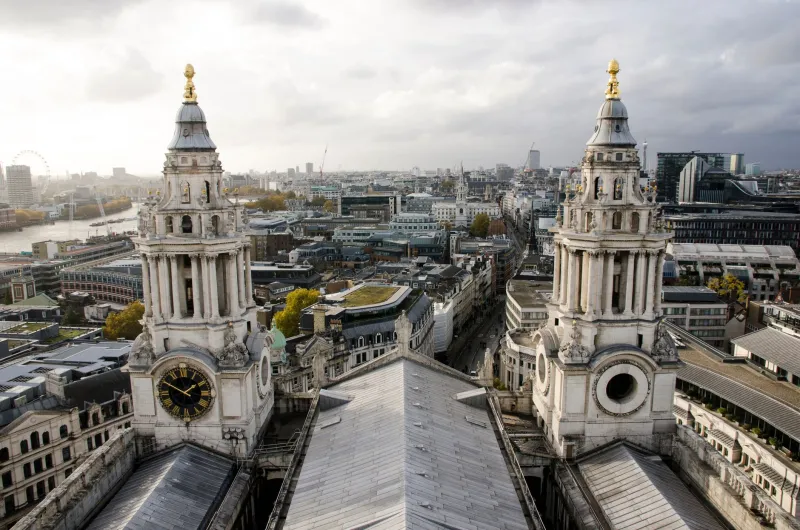
The City at half twelve is a contact sport. Sandwiches are being marched back to desks, Deliveroo bikes are threading through pedestrians, and every decent bench from Bank to St Paul's has a laptop bag on it. But the Square Mile has another kind of lunch spot, and it has been there for centuries: the churchyard. Postage-stamp graveyards, most of them, tucked behind office blocks and pub yards, with a gate that sticks and a stone or two that still has a name on it.
This is not a morbid tour. It is a practical one. A 90-minute loop, four stops, no booking, no queue, and a decent chance of hearing nothing but pigeons and a distant photocopier. The route runs from Monument to St Paul's, and it works best on a weekday when the City is busy and you want to be the one person not in a meeting.
The route at a glance
Start at Monument station at 12.15. Walk to St Olave Hart Street (5 minutes), then St Dunstan-in-the-East (10 minutes), then St Mary Aldermanbury (12 minutes), finishing at Postman's Park (10 minutes). That is about 40 minutes of walking; the rest is loitering. All four are public or accessible in some form, but they are not all open at the same times, and none of them is a park with a bin and a bench every ten paces.
| Stop | Access | Typical hours |
|---|---|---|
| St Olave Hart Street | Churchyard via the church | Weekdays, church hours — check the noticeboard |
| St Dunstan-in-the-East | Public garden | Daily, daylight hours |
| St Mary Aldermanbury | Public garden | Daily, daylight hours |
| Postman's Park | Public park | Daily, roughly 8am to dusk |
As of November 2026, the City's garden gates tend to follow daylight rather than a strict summer timetable, so do not turn up at 4.30pm in December expecting a long sit. Check ahead if you are making a special trip.
Stop one: St Olave Hart Street
Off Hart Street, a few minutes from Tower Hill, this is the City churchyard that feels most like a secret. The church is small and dark-bricked, with a skull-and-crossbones gateway that has been alarming passers-by for centuries. Samuel Pepys worshipped here; his wife, Elizabeth, is buried in the church. The churchyard itself is tiny — more a paved hem than a garden — and it is not the place for a full picnic.
That is the point. It is an active church, not a public square. If the gate is open, slip in, sit on the one bench, and look at the stones rather than your phone. The church is usually open on weekdays, but hours change, and the churchyard is not a guaranteed lunch spot. Treat it as the aperitif: five minutes of quiet before the main course.
Stop two: St Dunstan-in-the-East
This is the one people photograph. A ruined Wren church between Idol Lane and St Dunstan's Hill, roofless since the Blitz, now a garden with ivy climbing the tower and a lawn where the nave used to be. It is open daily and it is genuinely beautiful, which means it is also the busiest stop on this route. In summer, you will share it. In November, you will probably get a wall to yourself.
The story is simple and brutal: medieval church, rebuilt by Wren, bombed in 1941, left as a garden. What matters at lunchtime is that it works as a garden without pretending the church never existed. Sit on the low wall, eat something that does not rustle too loudly, and resist the urge to climb anything. The stones are old, and some of them are loose.
Stop three: St Mary Aldermanbury
A few minutes north, off Love Lane, is the strangest stop on the route. St Mary Aldermanbury was destroyed in the Great Fire, rebuilt by Wren, bombed in the Blitz, and then — in the 1960s — its remaining stones were shipped to Fulton, Missouri, to be rebuilt as a memorial. What is left in London is a garden, with the old foundations marked out and a memorial to John Heminges and Henry Condell, the two men who put together Shakespeare's First Folio.
It is a quiet, slightly melancholy space, and it is usually open during daylight hours. There is no café, no bin, no interpretive centre. Just a garden and a story that takes a minute to read and a while to sink in. This is the stop where you stop eating and start looking.
Stop four: Postman's Park
Finish at Postman's Park, off King Edward Street, which is not technically a churchyard any more but sits on the site of one and has the best ending of any lunch break in the City. The Watts Memorial — a wall of ceramic plaques commemorating ordinary people who died saving others — is the reason to come. It is Victorian, it is heartbreaking, and it is best read slowly, one plaque at a time.
The park is open daily, roughly 8am to dusk, and it has benches, which makes it the natural place to eat. It is also the busiest of the four at lunchtime, so if you want the quiet version, arrive before 12.30 or after 2.
The etiquette bit
These are not beer gardens with better stonework. They are burial grounds, gardens and active churchyards, and the difference matters. Keep calls off speaker. Do not balance a coffee cup on a ledger stone. Take your litter with you, because most of these places do not have a bin. Do not use a churchyard as a cut-through if a service is on. And if a gate is locked, do not rattle it — some of these spaces are opened by volunteers or church staff, and they close when they close.
The rule of thumb is library quiet, not silent. A whispered conversation is fine. A work call is not. A sandwich is fine. A picnic rug and a Bluetooth speaker are not. And if you find yourself reading a stone with a name and a date on it, that is the point. You are not on a bench. You are in someone's front room, historically speaking.
Practical notes
Start at Monument, finish at St Paul's, and allow 90 minutes if you want to sit at each stop. Tuesday to Thursday is the sweet spot: the City is in full swing, but the churchyards are not. Buy lunch before you start — there are no kiosks on this route — and keep it simple. A sandwich, a flask, an apple. The route is mostly step-free, but the City's pavements are uneven and the churchyard gates are not always wide.
And if it is raining? St Dunstan's has no roof, St Olave's has a small porch, and Postman's Park has trees that do not really count. This is a fair-weather crawl. The stones will still be there next week.