Round the Back: Six London Lanes That Tell the Real Story
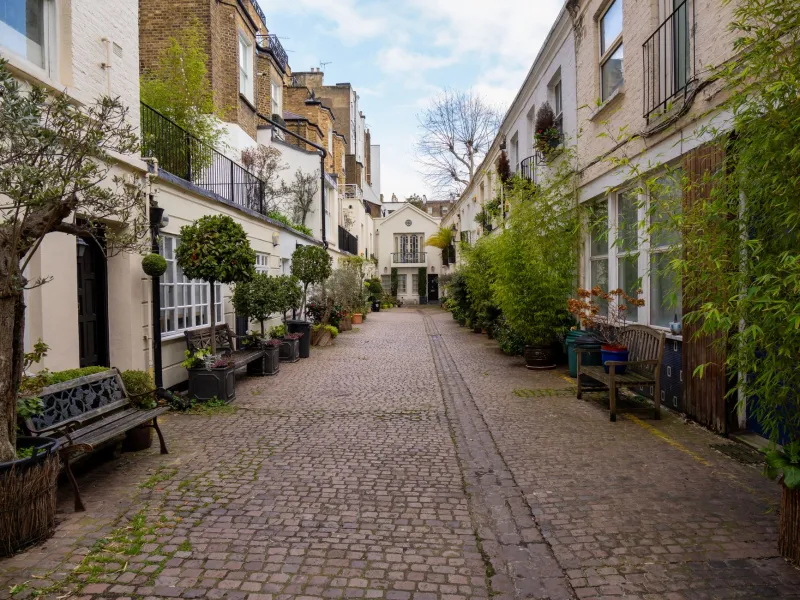
London is a city of front doors. The high street is the handshake: bright windows, bus stops, the usual rush. But the real street often runs behind it — a service lane, a stable block turned studio, a cut-through that saves you ten minutes and shows you a different neighbourhood entirely.
This is not about trespassing. It is about learning to read the city from its back edges. A good back-lane walk is slow, nosy in a polite way, and always aware of the line between public highway and someone’s shared courtyard. The rule is simple: tarmac and signposts usually mean public; gates, bollards and private notices mean no. Mews are often shared private land even when they look like streets. If in doubt, admire from the entrance and move on.
1. Soho: St Anne’s Court to Berwick Street
Start at Tottenham Court Road and slip into St Anne’s Court, a narrow public cut-through that feels like a service corridor with ideas above its station. Carry on to Meard Street, one of Soho’s quietest Georgian survivors, then angle across to Berwick Street for the market edge and the pubs that keep the neighbourhood honest. The Blue Posts is the obvious stop; the pleasure is in the in-between bits — basement bars, tiny shopfronts, doorways that look like deliveries and turn out to be something else entirely.
Access note: St Anne’s Court and Meard Street are public streets. Doorways, gated yards and residential entrances are private. Keep your voice down after dark; this is a lived-in neighbourhood, not a stage set.
2. Clerkenwell: Clerkenwell Close to St John’s Lane
From Farringdon, walk up Clerkenwell Close and let the scale drop. This is workshop London: jewellery benches, small studios, old warehouses with new signs and the occasional courtyard that looks inviting but is not yours to cross. Hook round via Pear Tree Court towards St John’s Lane, where the streets get narrower and the history gets heavier. Stop for a pint at The Sekforde if you are heading towards Woodbridge Street, or simply use the route as a quiet link between Farringdon and Smithfield.
Access note: Clerkenwell Close and Pear Tree Court are public streets. Rear courtyards and some building forecourts are private. If a gate is closed, it is closed for a reason.
3. Bermondsey: Morocco Street to Leathermarket
Begin at London Bridge and drop down Bermondsey Street, then turn into Morocco Street for the version of Bermondsey that existed before the brunch queue. Lamb Walk and Leathermarket Street give you old warehouse walls, stable-block proportions and the sense that the area was built for work, not for browsing. The Woolpack is a good pause on Bermondsey Street, but the real reward is the loop behind it — quiet, brick-heavy and strangely villagey for zone one.
Access note: The streets themselves are public. Several warehouse conversions have private courtyards and residential entrances; do not treat them as shortcuts. Some yards are working spaces, so keep clear of deliveries and shut gates.
4. Marylebone: Chiltern Street to Bickenhall Mews
Marylebone does polished frontage better than most, but its back lanes are where the neighbourhood loosens its collar. Start on Chiltern Street, cut through Moxon Street, and head for the edge of Bickenhall Mews — a classic stable-block mews with cobbles, garages and the faint sense that a horse should still be around the corner. The Gunmakers on Aybrook Street is the pub stop if you want to keep things traditional. This is a good route for a wet November afternoon when the high street is too busy and you want somewhere to walk with a purpose.
Access note: Chiltern Street and Moxon Street are public. Many mews are gated or privately maintained; Bickenhall Mews is best viewed from the street unless the entrance is clearly open to the public. Do not walk into private courtyards for a photograph.
5. Hackney Central: Reading Lane to Sutton Place
Hackney’s back edges are scruffier and more interesting than its main road. From Mare Street, take Reading Lane and then weave towards Sutton Place, where old industrial yards, workshops and stable-like buildings sit behind the shopping stretch. It is not pretty in the postcard sense; it is useful, layered and full of small businesses doing actual things. The Dolphin on Mare Street is the obvious pint, but the walk itself is the point — a reminder that Hackney’s high street has always been powered by the lanes behind it.
Access note: Reading Lane and Sutton Place are public roads. Industrial yards, forecourts and gated sites are private. Watch for vans, pallets and the fact that people are trying to work here.
6. Brixton: Atlantic Road to Valentia Place
Start at Brixton station and take Atlantic Road towards Brixton Village, then slide through the market arcades to Coldharbour Lane and on to Valentia Place. This is back-lane London with a soundtrack: railway arches, market back doors, delivery bikes and the smell of somebody’s lunch. The Duke of Edinburgh on Ferndale Road is a solid stop if you are extending the walk, but the best moments are in the market edges — the units that face the lane rather than the main drag.
Access note: The markets are public during trading hours; individual units and storage areas are private. Valentia Place is a public street, but surrounding yards and arches may not be. Check signs and do not slip through open gates just because they are open.
How to walk a back lane properly
Go in daylight first. Buy something small if you are lingering — a coffee, a pint, a paper. Keep your phone down when you are in residential mews. And remember that the back lane is not a secret to be conquered; it is a working part of the neighbourhood. The best London walks often run one street back from the obvious one, where the city is still doing its own thing.