Spend a Penny, See a Palace: London's Grandest Public Lavatories
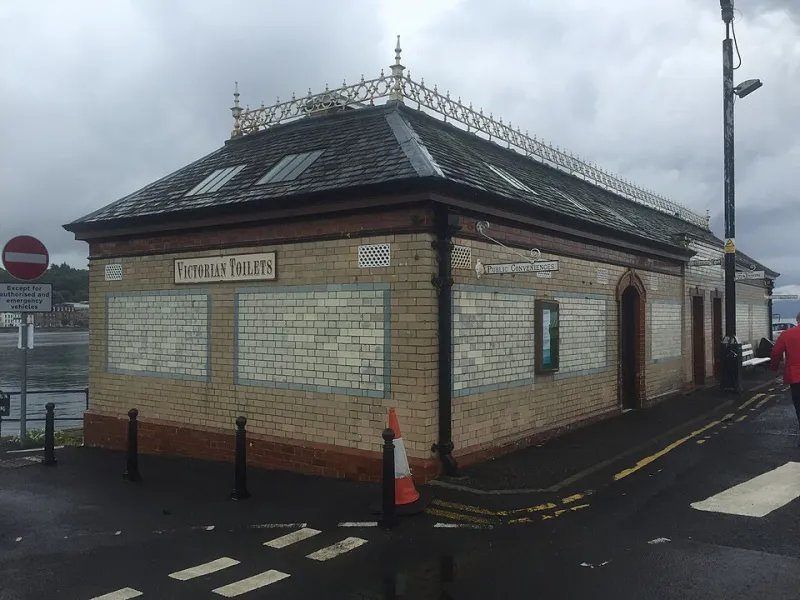
Photo: Kristijrn, CC BY-SA 4.0, via Wikimedia Commons
London is not short of monuments. It has an obelisk, several arches, a bronze woman on a very tall column and, at the last count, an almost embarrassing number of men on horses. What it's quietly running out of is the thing it once did better than almost any city on earth: the public convenience built as if it mattered.
A century and a half ago, lavatories were architecture. Vestries competed over them. Architects who spent their working lives on churches and board schools cheerfully signed off subterranean halls of glazed brick and brass, on the entirely rational grounds that a stranger caught short on the pavement is a stranger the city has failed. Some of those buildings are still standing. A handful still work.
Where the ambition came from
The Public Health Act of 1848 gave local bodies the powers and the prompting, and by the 1850s London was digging. The idea had been popularised at the Great Exhibition, where George Jennings's 'retiring rooms' charged a penny a go — a fee so embedded in the national brain that we've been saying 'spend a penny' ever since without thinking about it.
The Victorians put them underground wherever they could, because pavement was precious and a hole in the ground was cheaper than a building on top of it. What that produced, over the following fifty years, was a peculiar and rather moving building type: a public room, brightly tiled, well lit by pavement lights, and free of any expectation that you had paid to be there.
Start beneath Fitzrovia
Your first stop should be Foley Street, W1, where a late-Victorian gentlemen's convenience sat derelict and unloved for years before reopening in the early 2010s as a café. You come down a short flight of stone steps off the pavement and land in the original tiled chamber: cream and maroon glazed brick, a tiled dado, the old stall partitions now doing service as bench seating.
It's a genuinely strange and lovely room. Street noise arrives from above and slightly to one side, and the light has that underwater quality that only a basement gets. Come mid-morning for coffee and a pastry, or later for something stronger. Check the opening hours before you set off — it runs café hours, not civic ones, so an early-evening visit can be a wasted walk.
The holdout in Bloomsbury
Off Lamb's Conduit Street, at Guilford Place, WC1, sits one of the loveliest shuttered conveniences in London: a listed Victorian block with ornamental ironwork and steps curling down beneath the railings. It has been closed for years, revived in plans, and closed again; heritage campaigners have been circling it since before most of us could vote.
Go and look at it anyway. You can read the tilework and the scrollwork from street level, and it tells you the central problem of this whole subject in one glance. Listing protects a building's fabric. It doesn't guarantee a working tap.
The park pavilion, the brick box and the sun-trap
Above ground, the survivors fall into loose families. There's the Edwardian park pavilion — a small pitched-roof building in the corner of a Victorian park, often with an attendant's cupboard and a bit of decorative iron about it. The best of them feel like they've been designed by the same hand that did the park's bandstand, and sometimes they have.
There's the 1930s municipal block, and honestly, this is the one to admire. Cream faience, rounded corners, thin metal windows, sometimes a shallow copper roof that has gone the colour of a boiled sweet. If you want to understand what a London borough thought of itself in 1935, don't look at the town hall — look at the loo at the edge of the recreation ground.
And then there's the superloo, the automated self-cleaning cabin that arrived in the 1990s promising to solve everything and, in many boroughs, quietly stopped working and was lifted out again. Provision in the capital has been falling for decades; most counts put London's public toilets in the hundreds now. Several boroughs fill the gap with community toilet schemes, where pubs, cafés and libraries let you use theirs on the council's tab. It works surprisingly well, and it's worth knowing about if you're out with children or a weak bladder.
Practical notes before you go
- Hours: park conveniences generally follow park hours — roughly dawn to dusk, sometimes locked by 4pm in winter. City and café ones run their own timetables.
- Cost: free in most parks; many standalone blocks take a small coin fee, and contactless is slowly arriving. Carry a couple of coins anyway.
- Access: accessible cubicles are common but not universal. The Radar key scheme opens thousands of locked accessible toilets nationwide, and 'Changing Places' facilities for people with complex needs are listed by borough.
- Finding them: toilet-finder apps are patchy and out of date. Council website maps are more reliable, and park noticeboards more reliable still.
- Etiquette: the attendant has seen everything. Say hello.
Why bother
Because these buildings are the least boastful statement a city can make about itself. A monument says: look what we can afford. A public lavatory on a wet Tuesday says: we thought about you, and you hadn't even arrived yet.
London still builds spectacular things — glass towers, neon-lit shopping centres, a great deal of very expensive paving. But nowhere else in the city will you find such a direct, unspun record of what it once believed it owed a stranger. Go and stand in one before they're all cafés, or flats, or holes in the ground.